
Lemosho Route Trek 2026: The Long Beautiful Way Across Kilimanjaro

Lemosho Route Trek 2026: The Long Beautiful Way Across Kilimanjaro
The first thing many people notice on the Lemosho Route is the silence.
Not the silence of emptiness.
The silence of distance.
You feel it almost immediately after leaving the lower forest trails behind. The noise of roads disappears. Villages vanish beneath cloud cover. The mountain begins opening itself slowly, one landscape at a time, as if revealing different moods rather than different elevations.
Rainforest becomes moorland.
Moorland becomes volcanic wilderness.
Then finally, high alpine desert beneath enormous African sky.
And somewhere above all of it waits the summit of Mount Kilimanjaro.
White. Cold. Silent.
The Lemosho Route does not rush people toward the top.
It stretches the experience out intentionally.
Longer acclimatization.
Longer transitions.
Longer immersion inside the mountain itself.
That is why experienced guides quietly love this route.
Not because it is easy.
Because it allows the mountain to unfold properly.
For trekkers planning a Kilimanjaro climb in 2026, the Lemosho Route remains one of the most rewarding, scenic, and emotionally powerful ways to approach Africa’s highest peak.
Not only because of summit success.
But because of the journey across the mountain before sunrise finally touches Uhuru Peak.
Where the Lemosho Route Begins
Lemosho Route begins on the western side of Kilimanjaro, far from the busier southern approaches.
That western approach changes the atmosphere immediately.
The route feels remote from the beginning.
The drive toward Londorossi Gate passes through farmland, forest, and small settlements before entering dense montane rainforest alive with birds, insects, and monkey calls. Clouds drift low through giant trees while the mountain itself often remains hidden at first.
Kilimanjaro does this deliberately.
It reveals itself slowly.
And the Lemosho Route embraces that mystery beautifully.
Why the Lemosho Route Is Considered One of the Best
Among Kilimanjaro guides, the Lemosho Route carries a particular reputation.
Balanced.
Scenic.
Gradual.
Immersive.
It combines several major advantages:
- Excellent acclimatization profile
- Extraordinary scenery
- Lower crowd levels during early stages
- High summit success rates
- Diverse ecosystems
- Longer mountain immersion
Unlike shorter routes that push climbers upward quickly, Lemosho allows the body time to adapt naturally to altitude.
That matters enormously on Kilimanjaro.
Because the mountain is rarely defeated by fitness alone.
Altitude changes everything.
The Emotional Rhythm of the Lemosho Route
Some routes feel logistical.
The Lemosho Route feels cinematic.
Every day brings dramatic environmental changes. The mountain transforms constantly around you, creating the feeling of crossing several worlds layered vertically upon one another.
The experience becomes less about “reaching the summit” and more about moving through landscapes.
That distinction matters.
Because trekkers who focus only on the top often miss the emotional depth of the mountain itself.
And Kilimanjaro deserves attention long before summit night arrives.
Day One: Entering the Rainforest
The trek usually begins beneath thick rainforest canopy.
The air feels heavy and alive. Moisture clings to leaves while distant bird calls echo through the forest. Porters move steadily along muddy trails carrying enormous loads with calm efficiency that first-time climbers often find astonishing.
Then the monkeys appear.
Black-and-white colobus monkeys move gracefully through branches overhead while blue monkeys vanish silently into dense vegetation. Giant ferns line the trail. Moss hangs from ancient trees. Everything feels green.
Very green.
At this stage, many trekkers still feel energetic and conversational. The altitude remains low. Excitement dominates fatigue.
But experienced guides already begin repeating the phrase climbers will hear constantly across the mountain:
“Pole pole.”
Slowly slowly.
Kilimanjaro rewards patience more than speed.
The Shira Plateau: One of Kilimanjaro’s Most Beautiful Landscapes
After leaving the forest behind, the mountain opens dramatically.
The trail reaches the Shira Plateau — one of the most visually striking areas on Kilimanjaro.
Suddenly the landscape feels enormous.
Volcanic ridges stretch toward distant glaciers while giant groundsels and strange alpine plants rise from the moorland like something prehistoric. Clouds drift across wide open valleys while Mount Meru occasionally appears floating far below in the distance.
The air changes here too.
Cooler.
Drier.
Thinner.
And people begin walking more quietly.
Not only from fatigue.
From awe.
The Shira Plateau gives trekkers their first real sense of the scale of Kilimanjaro.
Why Acclimatization Matters So Much
Altitude does not care how athletic someone is.
Strong runners struggle.
Older trekkers succeed steadily.
Fitness helps, but adaptation matters more.
The Lemosho Route’s longer profile allows climbers to gain elevation gradually while giving the body more time to adjust naturally.
That is one reason summit success rates here are often higher than on shorter routes.
Good acclimatization includes:
- Slow walking
- Hydration
- Rest
- Consistent pacing
- Listening to guides carefully
And perhaps most importantly:
Humility.
Kilimanjaro punishes ego quickly.
Camp Life on the Mountain
Camp life becomes its own world on Kilimanjaro.
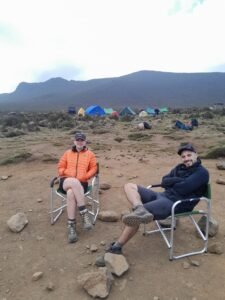
By late afternoon, tents appear against volcanic landscapes while porters move efficiently between camp kitchens, dining tents, and sleeping areas. Steam rises from hot tea in cold mountain air. Boots dry outside tents beneath enormous skies filled with stars.
People begin changing emotionally after several days on the mountain.
Phones matter less.
Time feels slower.
Conversations deepen.
Strangers often become close surprisingly quickly because the mountain strips away routine distractions. Everyone shares discomfort, effort, exhaustion, and uncertainty together.
And every evening, guides check climbers carefully for signs of altitude problems.
Good mountain crews never treat summit success casually.
Safety always comes first.
Lava Tower: The Mountain Begins Testing You
One of the most important acclimatization sections on the Lemosho Route involves climbing toward Lava Tower before descending again.
This section often feels emotionally difficult.
The altitude becomes noticeable. Breathing changes. Headaches sometimes begin mildly. The landscape turns increasingly barren and volcanic while clouds move quickly across dark rock formations.
Lava Tower itself rises dramatically from the alpine desert like a ruined fortress.
The mountain starts feeling less welcoming here.
More serious.
And that shift is important psychologically because climbers begin understanding that summit night will demand much more than enthusiasm alone.
Barranco Wall: Fear Before Confidence
The Barranco Wall intimidates many trekkers before they climb it.
From below, the steep volcanic face appears almost impossible.
Then morning arrives.
Headlamps disappear upward slowly through cold air while guides move carefully across the rock face showing climbers exactly where to place hands and feet.
And surprisingly, the climb becomes enjoyable.
Not easy.
But exhilarating.
People laugh nervously while navigating narrow ledges and scrambling sections. Below, the Barranco Valley stretches across the mountain in dramatic folds of mist and rock.
Reaching the top of the wall often gives trekkers a huge psychological boost.
Confidence grows.
The summit suddenly feels possible.
The Strange Beauty of High Altitude
Above certain elevations, Kilimanjaro becomes almost lunar.
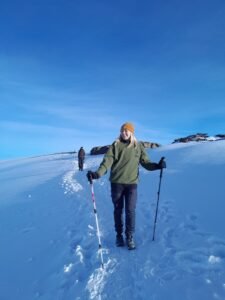
Vegetation disappears gradually until only rock, dust, ice, and sky remain. The silence deepens. Wind moves across barren volcanic slopes while glaciers appear startlingly white against black mountain terrain.
Nothing feels familiar anymore.
And yet many climbers describe this zone as strangely beautiful.
Minimal.
Cold.
Raw.
The mountain removes distractions completely at high altitude.
Only movement matters.
One step.
Another breath.
Another step.
Summit Night: Into the Darkness
Summit night begins in darkness.
Usually around midnight.
The cold shocks many climbers immediately after leaving tents. Headlamps form silent lines across volcanic slopes while boots crunch slowly over frozen scree beneath enormous African sky.
This is the hardest part of Kilimanjaro.
Not technically difficult.
Emotionally difficult.
Fatigue combines with altitude, cold, and darkness. Progress feels painfully slow. Conversations disappear almost completely as climbers focus inward.
Guides watch carefully.
Encouraging quietly.
Checking breathing.
Monitoring pace.
Hours pass strangely on summit night.
Time stretches.
Then finally, somewhere near Stella Point, the first pale light appears across the horizon.
And suddenly people realise:
They are above the clouds.
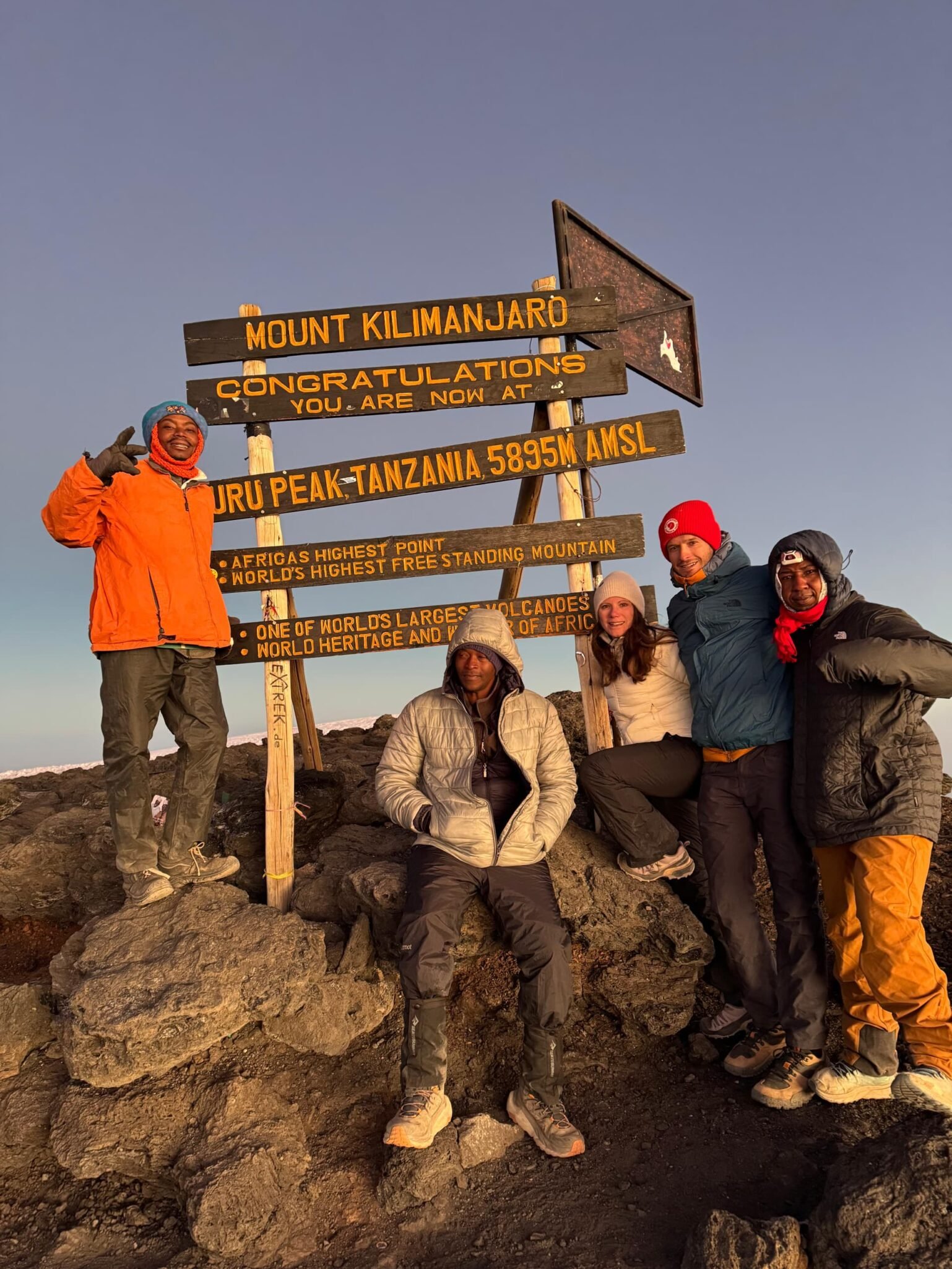
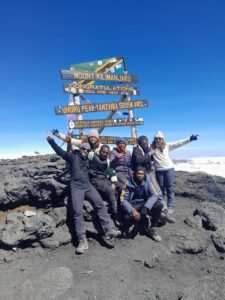
Sunrise at Uhuru Peak
Sunrise on Uhuru Peak does not feel triumphant in the way many people expect.
It feels emotional.
Quiet.
Exhausted climbers stand beside ancient glaciers while sunlight slowly spreads across Africa thousands of metres below. The curvature of clouds stretches endlessly toward the horizon. Ice glows gold in freezing air.
Some people cry.
Some sit silently.
Some simply stare.
Not because of achievement alone.
Because the mountain feels overwhelming in that moment.
The scale.
The effort.
The stillness.
Everything becomes strangely simple at the summit.
Descending the Mountain
Descending Kilimanjaro feels surreal.
Within hours, climbers move from frozen summit landscapes back toward warmer air and lower camps. Energy slowly returns as oxygen levels rise. People begin talking more again. Smiles appear more easily.
And almost immediately, memories begin forming.
Certain moments return repeatedly:
Headlamps moving silently before dawn.
Wind against volcanic ridges.
The first sight of glaciers at sunrise.
Porters singing softly in camp.
Kilimanjaro leaves fragments inside people.
Why the Lemosho Route Has High Summit Success
The Lemosho Route consistently performs well because it allows:
- Better acclimatization
- More gradual ascent
- Additional mountain days
- Stronger physical adaptation
- Reduced exhaustion before summit night
Longer itineraries often lead to significantly better summit experiences compared to rushed climbs.
That extra time matters enormously.
Not only physically.
Emotionally too.
Comparing Kilimanjaro Routes
| Route | Atmosphere | Difficulty | Scenery |
|---|---|---|---|
| Lemosho Route | Scenic & gradual | Moderate | Exceptional |
| Machame Route | Popular & dramatic | Moderate | Excellent |
| Marangu Route | Historic & direct | Moderate | Good |
| Rongai Route | Quiet & remote | Moderate | Unique northern views |
Among experienced mountain crews, Lemosho is often considered the most balanced overall experience.
The Porters: The Heart of Kilimanjaro
No Kilimanjaro story is complete without acknowledging the porters.
They carry equipment across extreme terrain with remarkable strength and resilience while often remaining cheerful even in difficult conditions.
Long before climbers wake, porters are already working.
Setting camp.
Boiling water.
Preparing meals.
Moving gear uphill.
And many climbers leave the mountain deeply moved by the kindness and professionalism of Tanzanian mountain crews.
The summit may belong to trekkers.
But the journey belongs to the entire team.
What the Mountain Teaches People
People arrive on Kilimanjaro for many reasons.
Adventure.
Challenge.
Celebration.
Personal goals.
But the mountain often gives something unexpected in return.
Perspective.
Modern life rarely allows sustained stillness anymore. Kilimanjaro forces it gently through rhythm and repetition. Walking hour after hour across changing landscapes creates mental quiet many travellers have not experienced in years.
And by summit day, something shifts.
The climb stops feeling like escape.
It starts feeling like reconnection.
Best Time to Climb the Lemosho Route in 2026
January to March
- Colder conditions
- Fewer crowds
- Beautiful snow near summit
- Dramatic skies
June to October
- Drier weather
- Clearer summit visibility
- Popular trekking season
- Excellent photography conditions
November
- Short rains possible
- Quieter mountain atmosphere
- Lush lower forest scenery
Each season changes Kilimanjaro emotionally and visually.
No climb feels exactly the same twice.
Combining Kilimanjaro With Safari and Zanzibar
Many travellers combine the Lemosho Route with:
This combination creates one of East Africa’s most complete journeys:
Mountain.
Wildlife.
Ocean.
Together they reveal different sides of Tanzania’s character.
Field Notes From Experienced Mountain Guides
“The mountain decides the pace. Not the climber.”
“People arrive focused on the summit. They leave remembering the journey.”
“Lemosho gives the mountain time to enter people slowly.”
“The silence near sunrise changes many climbers emotionally.”
Final Reflections: The Long Beautiful Way Up Kilimanjaro
The Lemosho Route is not simply a path to the summit of Mount Kilimanjaro.
It is a gradual immersion into the mountain itself.
Through rainforest.
Across volcanic plateaus.
Into high silent wilderness above the clouds.
And perhaps that is why so many climbers remember it so vividly long after returning home.
Not only because they stood on the Roof of Africa.
But because the route allowed them to feel the mountain properly before they ever reached the top.
Slowly.
Patiently.
Step by step through East African sky.
For trekkers planning Kilimanjaro in 2026, the Lemosho Route remains one of the finest ways to experience the mountain — scenic, emotionally rich, physically rewarding, and deeply connected to the wild rhythm of Tanzania itself. Book now your historic trek.




One thought on “Lemosho Route Trek 2026: The Long Beautiful Way Across Kilimanjaro”